TL;DR:
- Hiking boots are purpose-built for trail demands, offering better protection and ankle stability than regular shoes.
- Proper fit and quality materials ensure durability, comfort, and safety during challenging hikes.
- Investing in premium boots provides better long-term value through durability and reparability for frequent hikers.
Most hikers assume their favorite pair of running shoes or cross-trainers will handle any trail just fine. That assumption gets tested fast when you're scrambling over wet rocks, hauling a loaded pack, or navigating loose scree at altitude. Hiking boots aren't just another gear upgrade. They're purpose-built tools designed around the specific demands of the trail, and the difference between wearing the right footwear and the wrong kind can mean the difference between a great day out and a twisted ankle three miles from the trailhead. This article breaks down exactly what hiking boots offer, where the real value lies, and how to make a smart investment.
Key Takeaways
| Point | Details |
|---|---|
| Superior trail protection | Hiking boots defend your feet from hazards on rough and wet terrain. |
| Injury risk reduction | Proper boots help absorb impact and stabilize heavy loads, lowering some injury risks. |
| Long-term value | Investing in premium boots pays off with durability, comfort, and resoling options. |
| Myths debunked | Boot height alone does not prevent all ankle injuries; strength and stability are also vital. |
| Look beyond trends | Fit, materials, and real-world performance matter more than boot marketing or hype. |
What makes hiking boots different from regular shoes?
Before you hit the trail, it's crucial to understand what sets true hiking boots apart from everyday footwear. At first glance, a sturdy sneaker and a hiking boot might look similar. But the engineering underneath tells a very different story.
Hiking boots are built around a few core design principles that casual shoes simply don't share. High-top construction wraps around the ankle to limit unwanted side-to-side movement on uneven ground. Reinforced uppers, often made from full-grain leather or abrasion-resistant synthetics, protect your feet from rocks, roots, and brush. The outsoles use deep, multi-directional lugs to grip wet dirt, loose gravel, and slick surfaces. And the midsoles are far stiffer, which helps distribute pressure when you're stepping on sharp or irregular terrain.
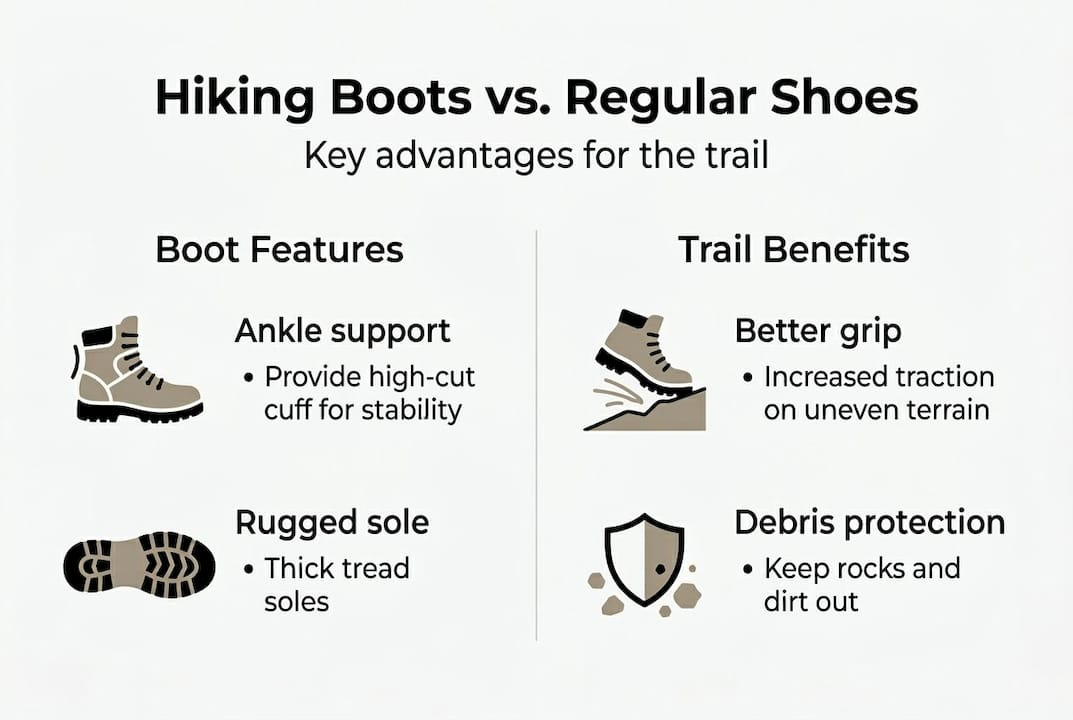
Quality hiking boots provide superior protection from rough terrain, ankle stability for heavy loads and technical trails, waterproofing to keep feet dry, and debris exclusion compared to regular shoes or cheap alternatives. That last point matters more than most people realize. A single sharp rock pressing through a thin sneaker sole for six hours will ruin a hike faster than bad weather.
Weatherproofing is another area where hiking boots pull ahead. Many models use Gore-Tex membranes or equivalent laminates that block water from outside while still allowing moisture vapor to escape. This keeps your feet dry during stream crossings, morning dew, and unexpected rain. Pairing your boots with other waterproof gear for adventurers creates a system that keeps you comfortable no matter the conditions.
Essential features to look for in hiking boots:
- High-top or mid-cut ankle collar for lateral stability
- Full-grain leather or reinforced synthetic uppers
- Waterproof membrane such as Gore-Tex
- Vibram or equivalent lug outsole
- Stiff, supportive midsole
- Reinforced toe cap and heel counter
- Breathable lining to manage moisture
| Feature | Hiking boots | Regular athletic shoes |
|---|---|---|
| Ankle support | High | Low |
| Sole stiffness | High | Low |
| Waterproofing | Yes (most models) | No |
| Debris protection | Yes | No |
| Typical lifespan | 500 to 1,000 miles | 300 to 500 miles |
| Terrain suitability | All trail types | Flat, groomed surfaces |
"Hiking boots are engineered to handle the unpredictability of natural terrain. Regular shoes are engineered for predictable surfaces. That gap in design intent is exactly why footwear choice matters so much on the trail."
Making sure your boots are part of a well-planned hiking essentials list ensures you're not leaving any critical layer of protection behind.
How hiking boots enhance safety and performance on the trail
Knowing the unique attributes of hiking boots sets the stage for understanding their true value during challenging hikes. The safety benefits go beyond simple protection. They reach into biomechanics and how your body handles stress over long distances.
One of the clearest advantages appears when you're carrying weight. Boots reduce tibial stress under heavy loads of 15 to 30 kg by redistributing forces through stiffness and ankle restriction, potentially lowering injury risk compared to lighter shoes. Your tibia, the main bone in your lower leg, absorbs enormous cumulative force on long descents. A stiffer boot spreads that force more evenly, reducing the localized stress that leads to shin splints and stress fractures.
Key trail conditions where hiking boots deliver clear advantages:
- Steep descents with loose rock or gravel
- Stream crossings and wet surfaces
- Long days carrying a loaded backpack
- Off-trail travel through dense brush
- Cold or wet weather conditions
- Technical scrambling on exposed ridgelines
| Trail condition | Risk in sneakers | Risk in hiking boots |
|---|---|---|
| Steep descent with pack | High (ankle roll, bruising) | Moderate (controlled) |
| Wet rock crossing | Very high (slipping) | Low (grip and waterproofing) |
| Heavy backpack on flat trail | Moderate (fatigue) | Low (load distribution) |
| Rocky off-trail terrain | High (sole penetration) | Low (stiff midsole) |
Learning how to pack a backpack efficiently also plays a role here. A poorly balanced pack shifts your center of gravity and increases the lateral forces on your ankles. Combine a heavy, unbalanced load with thin-soled shoes, and you have a recipe for a bad day. Good boots give you a fighting chance when things aren't perfectly balanced.
The performance side is just as compelling. Better grip means you move faster and with more confidence. A stiffer sole reduces foot fatigue on rocky ground. And proper fit inside a hiking boot, with a secure heel lock and enough toe room, prevents the blisters and black toenails that plague hikers who borrow their gym shoes for the trail.
Debunking the ankle support myth: What boots really offer
While safety and stability are often the first benefits cited, it's time to investigate one of the most popular beliefs about hiking boots. The idea that high-top boots prevent ankle sprains is repeated constantly in gear shops and online forums. The reality is more complicated.
Studies show boots limit range of motion but do not significantly reduce sprain rates compared to low-cut shoes. That's a meaningful distinction. A boot can restrict how far your ankle rolls, but if you step on a rock at the wrong angle with enough force, a sprain can still happen regardless of boot height. The research points to ankle strength and proprioception, your body's ability to sense joint position, as far more important factors in preventing sprains.Common myths and the truth about ankle support:
- Myth: High-top boots prevent all ankle sprains. Truth: They limit range of motion but don't eliminate sprain risk.
- Myth: Low-cut trail runners are always riskier. Truth: Fit, strength, and terrain awareness matter more than boot height.
- Myth: You don't need to train your ankles if you wear boots. Truth: Ankle strengthening exercises reduce injury risk more reliably than any boot design.
- Myth: Heavier boots mean more protection. Truth: Fit and sole quality matter more than weight.
"The evidence suggests that proprioceptive training and ankle strengthening are more effective at reducing sprain rates than footwear alone. Boots are part of the equation, not the whole answer."
Pro Tip: Combine a well-fitted hiking boot with a regular routine of single-leg balance work and calf raises. This combination gives you the structural support of the boot plus the neuromuscular readiness to react when the trail surprises you. Check out essential tips for beginners to build a complete preparation routine before your first serious hike.
The real value of a high-top boot on difficult terrain isn't sprain prevention. It's fatigue reduction, load management, and the confidence to move more decisively. Those benefits are real, even if they're less dramatic than the marketing suggests.
Cost versus value: Why premium hiking boots pay off
Beyond protection, wise hikers look to stretch their money while maximizing trail performance. The price range for hiking boots is wide, from budget options under $80 to premium models over $300. Knowing when to spend more, and when you don't need to, is a skill worth developing.
Cheap boots are adequate for casual and low-mileage use but fail in edge cases like heavy packs or abrasion. If you hike a few times a year on well-maintained trails, a mid-range boot will serve you well. But if you're covering serious miles, hauling heavy loads, or venturing into remote terrain, the limitations of budget boots show up quickly in the form of worn-out soles, delaminating uppers, and failed waterproofing.| Boot tier | Upfront cost | Estimated lifespan | Resolable | Best for |
|---|---|---|---|---|
| Budget | Under $80 | 200 to 400 miles | No | Casual day hikes |
| Mid-range | $100 to $200 | 400 to 700 miles | Sometimes | Regular trail hiking |
| Premium | $250 and up | 700 to 1,000+ miles | Yes | Frequent or technical hiking |
Signs that a hiking boot is worth the investment:
- Full-grain leather or high-denier synthetic upper
- Resolable construction with a quality welt
- Manufacturer warranty of at least one year
- Genuine waterproof membrane, not just a DWR coating
- Positive long-term reviews from frequent hikers
Pro Tip: When you buy premium boots, learn how to care for them properly. Clean them after muddy hikes, condition leather uppers regularly, and store them away from direct heat. When the soles wear down, get them resoled instead of replacing the whole boot. A good resole costs a fraction of a new pair and can add hundreds of miles to a boot you've already broken in perfectly.
Adding quality boots to your list of must-have hiking items is one of the smartest long-term investments you can make as an outdoor enthusiast.
Our take: Why careful boot selection beats hype and trends
With the facts, myths, and value comparisons in mind, let's get honest about what really helps on the trail. The outdoor gear market moves fast. New models drop every season with bold claims about revolutionary cushioning, next-generation waterproofing, and trail-dominating grip. Most of it is noise.
What we've seen time and again is that the hikers who stay comfortable and injury-free aren't necessarily wearing the newest boots. They're wearing boots that fit their specific feet well, suit the terrain they actually hike, and are made from materials that hold up over real miles. A boot that fits perfectly and has 200 miles on it will outperform a brand-new premium model that hasn't been broken in.
Fit is the single most important variable. A boot that's too wide lets your foot slide laterally. Too narrow and you get blisters and bruised toenails on descents. Too much volume in the toe box and your heel lifts with every step. These issues don't show up in a five-minute store test. They show up at mile eight.
Our advice: try multiple brands, walk on an incline in the store, and don't rush the decision. Build your hiking essentials around gear that has proven itself, not gear that looks good in photos. The trail doesn't care about trends.
Find the right hiking boots and more for your next adventure
Ready to invest in your outdoor journey? Make sure you're supported from the ground up.

At Life Camp Adventure, we're here to help you build a kit that actually works in the field. Whether you're researching your first pair of hiking boots or rounding out your trail setup, our adventure survival gear checklist gives you a practical framework for what you need and why. For a broader look at what's worth buying, our best camping gear comparison breaks down top options across categories so you can make confident, informed choices. Good gear starts with good information, and we're committed to giving you both.
Frequently asked questions
Do hiking boots really prevent injuries?
Hiking boots reduce risks like bruised feet, debris exposure, and fatigue-related slips, but boots don't significantly lower ankle sprain rates compared to low-cut shoes. Ankle strength and proprioception remain the most important injury prevention factors.
Is it worth spending extra on premium hiking boots?
For frequent or technical hikers, yes. Premium boots offer better long-term value through resolable construction, superior materials, and more reliable performance under demanding conditions.
Should beginners invest in hiking boots or use regular sneakers?
On short, flat, well-maintained trails, sneakers can work. But cheap boots fail in edge cases like heavy packs or rough terrain, so even beginners benefit from a proper mid-range hiking boot as they build experience.
What features are most important in a good hiking boot?
Quality hiking boots provide superior protection through ankle stability, waterproofing, debris exclusion, and durable uppers. Fit is equally critical and should never be compromised for price or aesthetics.
How long do hiking boots last?
With proper care, quality boots last 500 to 1,000 miles or several years of regular use. Premium boots offer better longevity through resolable construction, which can extend their life significantly beyond the original sole.
